
Chapter 10. The Human Eye and the Colourful World
CHAPTER 10 solutions in english medium Best wishes by Nitish sir 🤞🤞
-------------------------------------------------------------------------------------
page 170
EXERCISE QUESTIONS
Question 1
The human eye can focus objects at different distances by adjusting the focal length of the eye lens. This is due to
(a) presbyopia
(b) accommodation
(c) near – sightedness
(d) far – sightedness
Answer:
(b) Accommodation
Question 2
The human eye forms the image of an object at its
(a) cornea
(b) iris
(c) pupil
(d) retina
Answer:
(d) Retina
Question 3
The least distance of distinct vision for a young adult with normal vision is about
(a) 25 m
(b) 2.5 cm
(c) 25 cm
(d) 2.5 m
Answer:
(c) 25 cm
Question 4
The change in focal length of an eye lens is caused by the action of the
(a) pupil
(b) retina
(c) ciliary muscles
(d) iris
Answer:
(c) Ciliary muscles
Question 5
A person needs a lens of power -5.5 dioptres for correcting his distant vision. For correcting his near vision he needs a lens of power +1.5 dioptre. What is the focal length of the lens required for correcting (i) distant vision, and (ii) near vision ?
Solution:
page 170
EXERCISE QUESTIONS
Question 1
The human eye can focus objects at different distances by adjusting the focal length of the eye lens. This is due to
(a) presbyopia
(b) accommodation
(c) near – sightedness
(d) far – sightedness
Answer:
(b) Accommodation
Question 2
The human eye forms the image of an object at its
(a) cornea
(b) iris
(c) pupil
(d) retina
Answer:
(d) Retina
Question 3
The least distance of distinct vision for a young adult with normal vision is about
(a) 25 m
(b) 2.5 cm
(c) 25 cm
(d) 2.5 m
Answer:
(c) 25 cm
Question 4
The change in focal length of an eye lens is caused by the action of the
(a) pupil
(b) retina
(c) ciliary muscles
(d) iris
Answer:
(c) Ciliary muscles
Question 5
A person needs a lens of power -5.5 dioptres for correcting his distant vision. For correcting his near vision he needs a lens of power +1.5 dioptre. What is the focal length of the lens required for correcting (i) distant vision, and (ii) near vision ?
Solution:
(i) Distant Vision :Given,Power =5.5DPower, P=1fFocal length, f=1P⇒f=1−5.5
⇒f=10−55
⇒f=2−11
⇒f=−0.181m
⇒f=−18.1cm
(ii) Near Vision :Given,Power =1.5DP=1f
f=1P
⇒f=11.5
⇒f=1015
⇒f=23
⇒f=0.667m
⇒f=66.7cm
Question 6
The far point of a myopic person is 80 cm in front of the eye. What is the nature and power of the lens required to correct the problem ?
Solution:
For a myopic person concave lens is used to correct the problem.Focal length = Distance of far point from eye
Hence, f = -80 cm = -0.8 m.
The power of the lens can be obtained as:
Question 6
The far point of a myopic person is 80 cm in front of the eye. What is the nature and power of the lens required to correct the problem ?
Solution:
For a myopic person concave lens is used to correct the problem.Focal length = Distance of far point from eye
Hence, f = -80 cm = -0.8 m.
The power of the lens can be obtained as:
P=1f
P=1(−0.8)=-1.25 D
Question 7
Make a diagram to show how hypermetropia is corrected. The near point of a hypermetropic eye is 1 m. What is the power of the lens required to correct the defect ? Assume that the near point of the normal eye is 25 .
Solution:
Hypermetropia can be corrected by using a convex lens. A convex lens converges the incoming light such that the image is formed on the retina.
Question 7
Make a diagram to show how hypermetropia is corrected. The near point of a hypermetropic eye is 1 m. What is the power of the lens required to correct the defect ? Assume that the near point of the normal eye is 25 .
Solution:
Hypermetropia can be corrected by using a convex lens. A convex lens converges the incoming light such that the image is formed on the retina.
An object at 25 cm forms an image at the near point of the hypermetropic eye. Here, near point is 1 m.
Given,
Object distance,u=−25 cm
Image distance, v=−100 cm
From lens formula, 1v−1u=1f
1−100−1−25=1f
Focal length,f=100/3 cm=1/3 m
Power, P=1f=11/3=3 D

Question 8
Why is a normal eye not able to see clearly the objects placed closer than 25 cm ?
Answer:
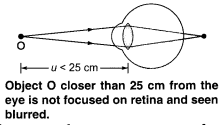
At distance less than 25 cm, the ciliary muscles cannot bulge the eye lens any more, the object cannot be focused on the retina and it appears blurred to the eye, as shown in the given figure.
Question 9
What happens to the image distance in the eye when we increase the distance of an object from the eye ?
Answer:
There is no change in the image distance in the eye when we increase the distance of an object from the eye. To see close or distant objects clearly, due to its ability of accommodation, eye can increase or decrease the focal length of its lens so that the image is always formed at the retina.
Question 8
Why is a normal eye not able to see clearly the objects placed closer than 25 cm ?
Answer:
At distance less than 25 cm, the ciliary muscles cannot bulge the eye lens any more, the object cannot be focused on the retina and it appears blurred to the eye, as shown in the given figure.
Question 9
What happens to the image distance in the eye when we increase the distance of an object from the eye ?
Answer:
There is no change in the image distance in the eye when we increase the distance of an object from the eye. To see close or distant objects clearly, due to its ability of accommodation, eye can increase or decrease the focal length of its lens so that the image is always formed at the retina.
Question 10
Why do stars twinkle ?
Answer:
Stars appear to twinkle due to atmospheric refraction. The light of star after the entry of light in earth’s atmosphere undergoes refraction continuously till it reaches the surface of the earth. Stars are far away. So, they are the point source of light. As the path of light coming from stars keep changing, thus the apparent position of stars keep changing and amount of light from stars entering the eye keeps twinkling. Due to which a star sometimes appear bright and sometimes dim, which is the effect of twinkling.
Question 11
Explain why the planets do not twinkle ?
Answer:
The planets are much nearer to the earth than stars and because of this they can be considered as large source of light. If a planet is considered to be a collection of a very large number of point sources of light, then the average value of change in the amount of light entering the eye from all point size light sources is zero. So, planets do not appear to twinkle..
Question 12
Why does the sun appear reddish early in the morning ?
Answer:
The light coming from the sun passes through various denser layers of air in the earth’s atmosphere before reaching our eyes near the horizon. Most of the part of blue light and light of small wavelength gets scattered by dust particles near the horizon. So, the light reaching our eyes is of large wavelength. Due to this the sun appears reddish at the time of sunrise and sunset.
Question 13
Why does the sky appear dark instead of blue to an astronaut ?
Answer:
As an astronaut moves away from the atmosphere of earth, the atmosphere becomes thin. Due to the absence of molecules (or dust particles) in air, the scattering of light does not take place. Thus, sky appears dark in the absence of scattering.
Question 10
Why do stars twinkle ?
Answer:
Stars appear to twinkle due to atmospheric refraction. The light of star after the entry of light in earth’s atmosphere undergoes refraction continuously till it reaches the surface of the earth. Stars are far away. So, they are the point source of light. As the path of light coming from stars keep changing, thus the apparent position of stars keep changing and amount of light from stars entering the eye keeps twinkling. Due to which a star sometimes appear bright and sometimes dim, which is the effect of twinkling.
Question 11
Explain why the planets do not twinkle ?
Answer:
The planets are much nearer to the earth than stars and because of this they can be considered as large source of light. If a planet is considered to be a collection of a very large number of point sources of light, then the average value of change in the amount of light entering the eye from all point size light sources is zero. So, planets do not appear to twinkle..
Question 12
Why does the sun appear reddish early in the morning ?
Answer:
The light coming from the sun passes through various denser layers of air in the earth’s atmosphere before reaching our eyes near the horizon. Most of the part of blue light and light of small wavelength gets scattered by dust particles near the horizon. So, the light reaching our eyes is of large wavelength. Due to this the sun appears reddish at the time of sunrise and sunset.
Question 13
Why does the sky appear dark instead of blue to an astronaut ?
Answer:
As an astronaut moves away from the atmosphere of earth, the atmosphere becomes thin. Due to the absence of molecules (or dust particles) in air, the scattering of light does not take place. Thus, sky appears dark in the absence of scattering.
Inside Chapter's question
Page 164
Question 1.
What is meant by power of accommodation of the eye?
Answer:
The power Of accommodation of the eye is the ability of the eye to observe the distinct objects clearly which are situated at a large distance from the eye. The ciliary muscles are responsible to change the focal length Of the eye lens. The value of the power of accommodation Of the normal human eye is (d = 25 cm) = 100/f = 100/d = 100/25 = 4 dioptres. The value of power of accommodation Of human eye is about 4D
Question 2.
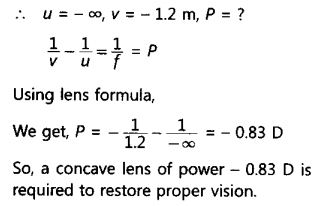
A person with a myopic eye cannot see objects beyond 1.2 m distinctly. What should be the type of the corrective lens used to restore proper vision?
Answer:
The far point for myopic eye is 1.2m.
Question 3.
What is the far point and near point of the human eye with normal vision ?
Answer:
For human eye with normal vision, far point is at infinity and near point is at 25 cm from the eye.
Question 4.
A student has difficulty reading the blackboard while sitting in the last row. What could be the defect the child is suffering from ? How can it be corrected ?
Answer:
As the child has difficulty in reading the blackboard, he is suffering from myopia or short sightedness. To correct this defect, he has to use spectacles with concave lens of suitable focal length.
Question 1.
What is meant by power of accommodation of the eye?
Answer:
The power Of accommodation of the eye is the ability of the eye to observe the distinct objects clearly which are situated at a large distance from the eye. The ciliary muscles are responsible to change the focal length Of the eye lens. The value of the power of accommodation Of the normal human eye is (d = 25 cm) = 100/f = 100/d = 100/25 = 4 dioptres. The value of power of accommodation Of human eye is about 4D
Question 2.
A person with a myopic eye cannot see objects beyond 1.2 m distinctly. What should be the type of the corrective lens used to restore proper vision?
Answer:
The far point for myopic eye is 1.2m.
Question 3.
What is the far point and near point of the human eye with normal vision ?
Answer:
For human eye with normal vision, far point is at infinity and near point is at 25 cm from the eye.
Question 4.
A student has difficulty reading the blackboard while sitting in the last row. What could be the defect the child is suffering from ? How can it be corrected ?
Answer:
As the child has difficulty in reading the blackboard, he is suffering from myopia or short sightedness. To correct this defect, he has to use spectacles with concave lens of suitable focal length.
Comments
Post a Comment