
NCERT Solutions for Class 10 Science Chapter 7 Control and Coordination
Question 1
What is the difference between a reflex action and walking?
Answer:
| Reflex action | Walking |
| 1. It is the action which is performed automatically. | 1. It is a response to the information transmitted by nerve to muscles of the legs. In this case, thinking is involved. |
| 2. It is controlled and coordinated by spinal cord. | 2. Brain instructs and controls leg muscles to move. |
| 3. It is an involuntary action. | 3. It is a voluntary action. |
Question 2
What happens at the synapse between two neurons?
Answer:
The small empty space between two nerve cells is called synapse. At synapse, a chemical substance is produced at the end of axon of one nerve cell that reaches to the other nerve cell through the dendrite. Thus, information is transmitted from one nerve cell to other nerve cell by synapse.
Question 3
Which part of the brain maintains posture and equilibrium of the body ?
Answer:
Posture and equilibrium of the body are controlled by cerebellum.
Question 4
How do we detect the smell of an agarbatti (incense stick) ?
Answer:
The smell of agarbatti (incense stick) diffuses in the air. It is detected by olfactory receptors present in the nose. This information is sent to olfactory lobe by sensory nerves located in the forebrain. It responds to the information.
Question 5
What is the role of the brain in reflex action ?
Answer:
There is no role of brain in reflex action. These involuntary actions are controlled by the spinal cord which take place immediately without thinking of how to respond to the stimuli.
Question 1
What are plant hormones ?
Answer:
Plant hormones are also called phytohormones. Plant hormones are the chemical substances which help in controlling growth, flowering, height, development of plants and their response to the environment.
Different types of phytohormones are – auxins, gibberllins, cytokinins, abscisic acid and ethylene.
Question 2
How is the movement of leaves of the sensitive plant different from the movement of a shoot towards light ?
Answer:
| Movement of leaves of sensitive plant | Movement of a shoot towards light |
| 1. It is a nastic movement which does not depend on the direction of stimulus applied. | 1. It is a tropic movement which depends on the direction of stimulus applied. |
| 2. The stimulus is touch. | 2. The stimulus is light. |
| 3. It is caused by the sudden loss of water from the swellings at the base of leaves. | 3. It is caused by the unequal growth on the two sides of the shoot. |
| 4. It is not a growth movement. | 4. It is a growth movement. |
Question 3
Give an example of a plant hormone that promotes growth.
Answer:
Auxin.
Question 4
How do auxins promote the growth of a tendril around a support ?
Answer:
When the tip of a tendril touches a support, then the auxins present in its tip move to that side of tip which is away from the support. Auxins promote growth. So, due to more auxins in it, the side of tendril away from the support grows faster (and becomes longer) than the side which is in contact with the support and makes the tendril twirl (or bend) around the support.
Question 5
Design an experiment to demonstrate hydrotropism.
Answer:
Take two glass troughs A and B and fill each one of them two-thirds with soil. In trough A plant a tiny seedling. In trough B plant a similar seedling and place a c/ay pot inside the soil. Water the soil in trough A daily and uniformly. Do not water the soil in trough B but put some water in the clay pot. Leave both the troughs for a few days.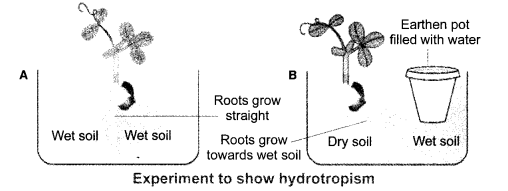
Now, dig up the seedlings carefully from both the troughs without damaging their roots. We will find that the root of seedling in trough A is straight. On the other hand, the root of seedling in trough B is found to be bent to the right side i.e., towards the clay pot containing water.
In trough A, the root of the seedling gets water from both sides. But in trough B, the roots get water oozing out from the clay pot which is kept on the right side. Therefore, the root of seedling in trough B grows and bends towards the source of water to the right side. This experiment shows that the root of a plant grows towards water. In other words, the root of a plant is hydrotropism.
Question 1
How does chemical coordination take place in animals ?
Answer:
Chemical coordination in animals takes place through the hormones secreted by the endocrine glands. Coordination in animals takes place through hormone system as well as nervous system which is called endocrine system. Endocrine glands secrete animal hormones directly into the blood that reach to the specific cells. Special type of molecules are present on the surface of cells to detect these hormones. These cells act according to the information that a particular hormone carries.
Question 2
Why is the use of iodised salt advisable ?
Answer:
It is advised to use iodised salt because thyroid gland needs iodine to produce thyroxin hormone. Thyroxin hormone controls all the metabolic activities of our body like metabolism of carbohydrates, fats and protein etc. Due to the deficiency of thyroxin a disease called goitre is caused.
Question 3
How does our body respond when adrenaline is secreted into the blood ?
Answer:
The heart beat increases when adrenaline is secreted into the blood so that more oxygen is supplied to our muscles. The blood supply to the digestive system and skin decreases because the small arteries around the muscles of these organs contract. This turns the direction of blood towards our skeletal muscles. The breathing rate also increases due to the contractions of the diaphragm and rib muscles. All these responses enable us to face the situations of fear and anger.
Question 4
Why are some patients of diabetes treated by giving injections of insulin ?
Answer:
Insulin hormone regulates blood sugar levels. If this is not secreted in proper amounts, the sugar level in the blood rises. This causes many harmful effects.
To treat harmful effects of increased level of blood sugar, the diabetic patients are treated by giving injections of insulin.
NCERT Solutions for Class 10 Science Chapter 7 Textbook Chapter End Questions
Question 1
Which of the following is a plant hormone?
(a) Insulin
(b) Thyroxin
(c) Oestrogen
(d) Cytokinin
Answer:
(d) Cytokinin
Question 2
The gap between two neurons is called a
(a) dendrite
(b) synapse
(c) axon
(d) impulse
Answer:
(b) Synapse
Question 3
The brain is responsible for
(a) thinking
(b) regulating the heart beat
(c) balancing the body
(d) all of the above
Answer:
(b) All of the above
Question 4
What is the function of receptors in our body ? Think of situations where receptors do not work properly. What problems are likely to arise ? [AICBSE 2016]
Answer:
Receptors are specialised cells located in our sense organs like ear, nose, skin, tongue and eyes. The function of receptors is to detect information from the environment. For example, olfactory receptors detect smell. If receptors do not work properly, the information obtained from the environment will be delayed to reach the spinal cord or brain. In this situation, the response to the environmental stimulus will be delayed causing harm to the body. For example, if skin receptors are damaged, and one accidentally touches a hot object, then his/her hands might get burn as the damaged receptor cannot perceive the external stimuli of heat and pain.
Question 5
Draw the structure of a neuron and explain its function. [AICBSE 2017]
Answer:
Nerve cell or neuron is the functional unit of nervous system. A nerve cell has three parts-
(i) cell body
(ii) dendrite
(iii) axon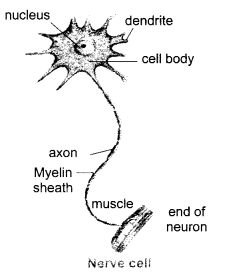
Function : The function of nerve cells is to carry information in the form of electrical signals which are called nerve impulses. Cells receive stimulus to send it to spinal cord and brain and carry the message from brain to the target organ.
Question 6
How does phototropism occur in plants ?
Answer:
The movement in any part of a plant due to light is called phototropism. The shoot of plant shows positive phototropism and roots show negative phototropism.
Phototropism in plants occurs due to the hormone auxin. When light falls on one side of a plant, the secretion of auxin hormone is more in the part away from the light. Hence, auxin causes growth in length of the cells in shady part. So, the plant appears to bend towards light.
Question 7
Which signals will get disrupted in case of a spinal cord injury ?
Answer:
(i) All the involuntary actions will get disturbed.
(ii) Reflex actions will be disturbed because reflexes are located in the spinal cord. Therefore, the quick responses required to safe guard the body will not take place.
Question 8
How does chemical coordination occur in plants ?
Answer:
Chemical coordination in plants takes place with the help of plant hormones. In most of the regions where division takes place (meristematic regions) stimuli cells secrete chemical compounds (hormone). These substances identify the information by stimulating the other nearby cells and communicating the information.
Question 9
What is the need for a system of control and coordination in an organism ?
Answer:
An organism needs control and coordination system for the following functions :
(i) To save the body of the organisms from the harmful changes in the environment.
(ii) To control the speed of voluntary and involuntary actions.
(iii) To have the capability to think and learn for responding to any stimuli.
Question 10
How are involuntary actions and reflex actions different from each other ?
Answer:
| Involuntary actions | Reflex actions |
| 1. Those actions which occur immediately without any thinking are called involuntary actions. | 1. Reflex action is an immediate response to an event which does not require any processing by brain. |
| 2. Involuntary actions are controlled by mid and hind brain. Example: Breathing, beating of heart, etc. | 2. Reflex actions are controlled by spinal cord. Example: Sneezing, coughing, etc. |
Question 11
Compare and contrast nervous and hormonal mechanisms for control and coordination in animals.
Answer:
| Nervous mechanism | Hormonal mechanism |
| It is a fast process. | It is a slow process. |
| Arteries and glands are affected. | It affects the target organ. |
| It transmits in electrochemical form. | It transmits in chemical form. |
| It does not control metabolism. | It controls metabolism. |
| Growth is not affected. | Growth is affected. |
Question 12
What is the difference between the manner in which movement takes place in a sensitive plant and the movement in our legs ?
Answer:
| Movement in a sensitive (mimosa) plant | Movement in legs of a human |
| 1. The leaves of a sensitive plant like mimosa are sensitive to touch. | 1. Leg is in control of nerve muscles. |
| 2. It is not controlled by any part of the plant. | 2. It is controlled by brain and spinal cord. |
| 3. In this, cells change their shape on changing the amount of water in them. | 3. Amount of water has no effect on the movement of muscles. |
| changing the amount of water in them. | the movement of muscles. |
| 4. The movement in a sensitive plant are nastic movement. | 4. The movement in our leg is due to voluntary nervous system. |
Comments
Post a Comment